Given that the objective is not to design a gas-preheating burner
system, but rather to study the transient mechanical response of
the cell during preheating, the boundary conditions on the top
surface of the cathode block were kept very simple. A heat
transfer coefficient of 650 W/m
72 hours.
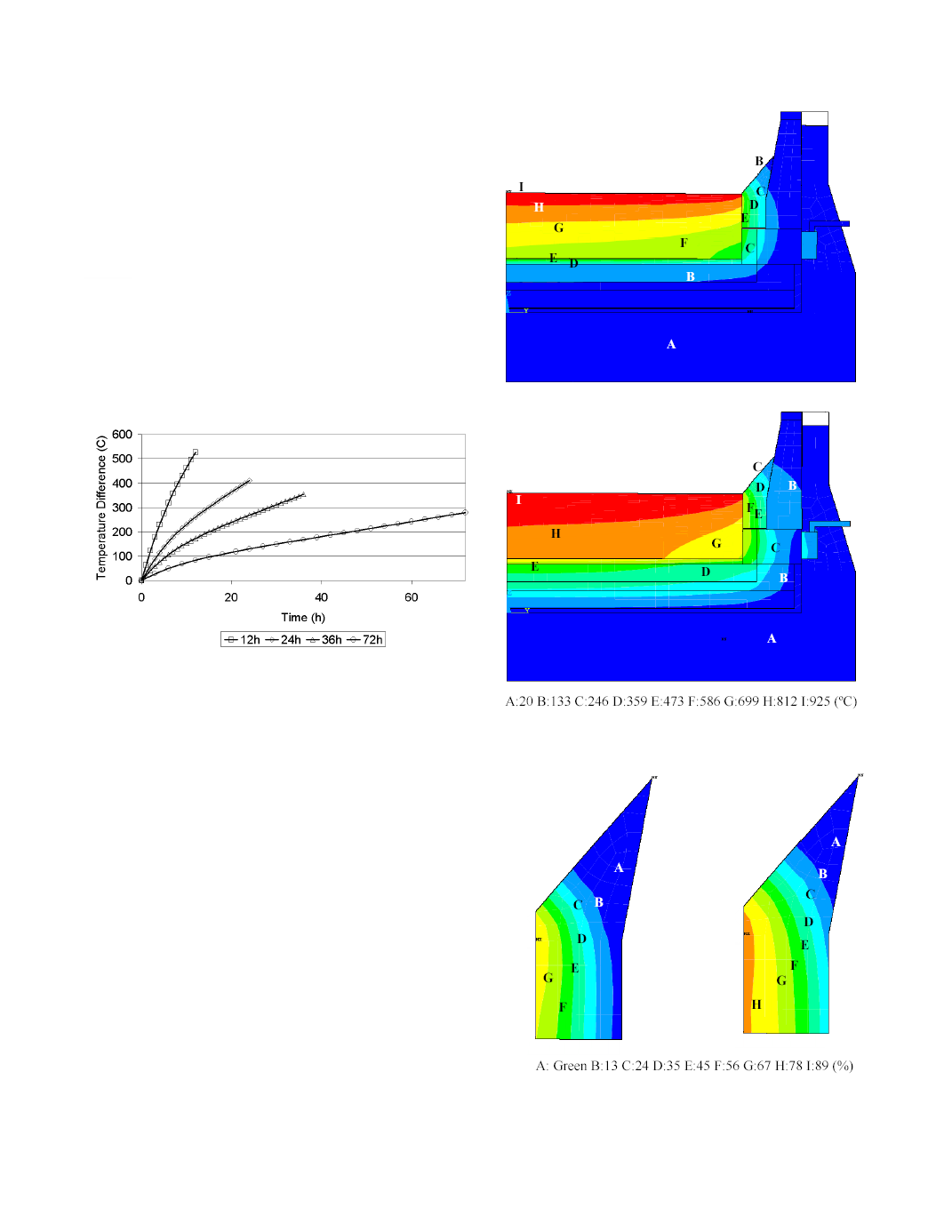
the cell are within 20ºC for all simulations. As expected, the
thermal gradients within the cathode blocks are decreasing with
the increasing preheating time. For instance, Figure 6 represents
the difference between the surface and sub-cathodic temperature
at the end of the cathode block (adjacent to the ramming paste,
between the collector bars).
24 and 72 hours. The large thermal inertia of the lining is such
that even after 72 hours of preheating, the shell floor and most of
the shell sidewall are still cold (Figure 7b). Note that the
discontinuity in the isotherms is a result of the thermal resistance
of the interface between the parts.
An interesting effect of the transient diffusion of heat into the
lining is that the extent of baking of the ramming paste changes
dramatically with the preheating time, as shown in Figure 8. Note
that the local baking index is defined as the paste local
compressive strength normalized to its strength at full baking
(refer to [6] for more details).
After 24 hours of preheating, some of the paste in the line of
action of the cathode block expansion is still completely green
(Figure 8a), i.e. it is still plastic. This is not the case for a
preheating of 72 hours (Figure 8b). The baking of the paste must
be taken into account in the design of a start-up method. Green
paste deforms to accommodate the expansion of the cathode
blocks, but it also shrinks when it starts to bake. The timing of this
process must be such that no gap will open where bath could leak
into the lining when the bath is poured in the cell after the
preheating is completed.