Furthermore, in the context of a cell stability analysis, it is important to solve for
evolution of the cell under study as this will have an impact on the magnetic field
perturbation. For this reason, the 1D electrical network solved by MHD-Valdis
represents several cells in the neighbourhood of the test cell (see Figure 5).
That main electrical network is complemented by additional, electrically
solving the cathode block collector bar connection and the collector bar current pickup,
and another continuous domain to compute the current field in the two liquid zones. It is
important to notice that the solution presented in Figure 6 has been computed in only a
few CPU seconds.
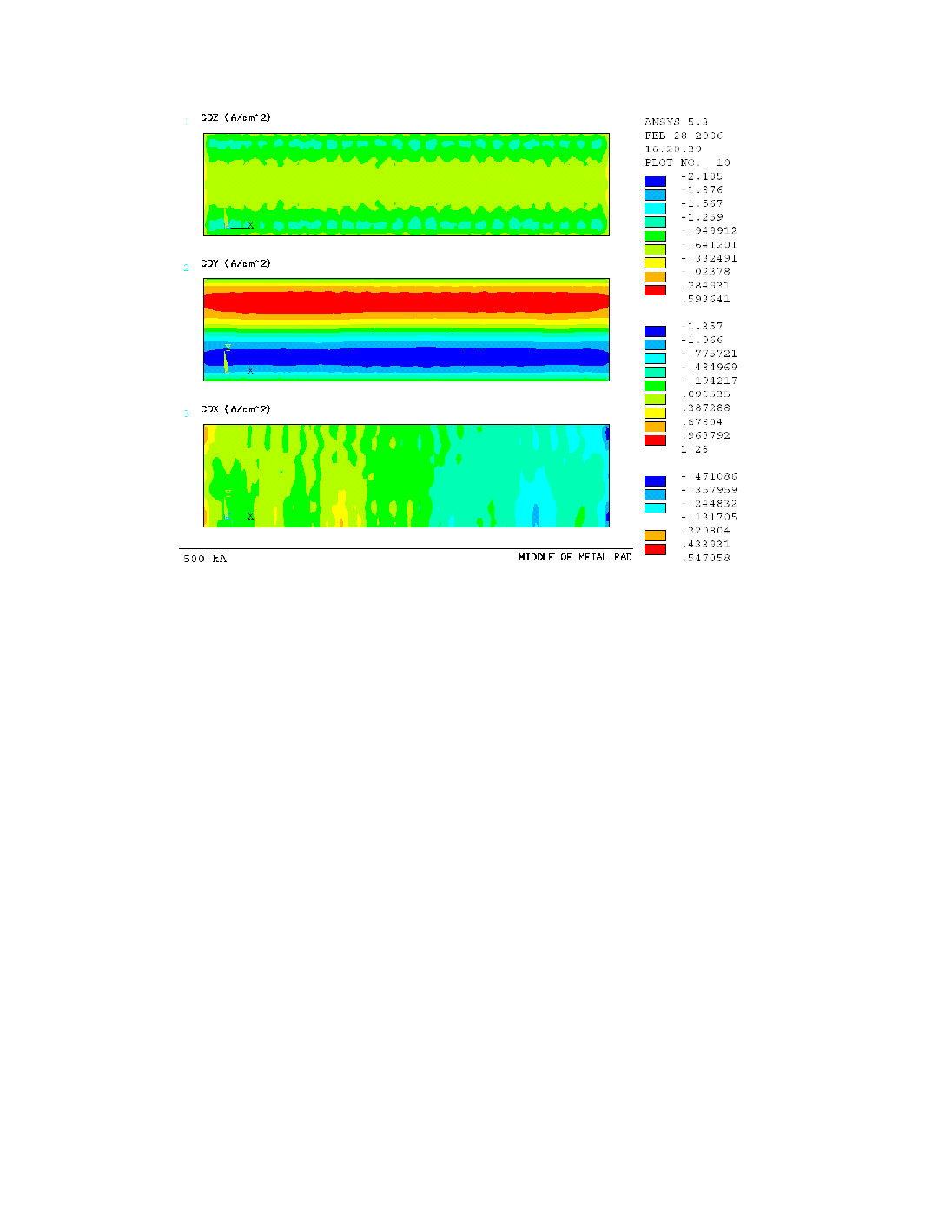
By comparing Figures 2, 4 and 6, we can see that MHD-Valdis is computing
density field. When comparing those three figures, it is important to point out that for the
two ANSYS® based models, CDZ (A/cm2) is the vertical component of the current
density in the middle plane of the metal pad while for MHD-Valdis, JB (A/m2) is the
vertical component of the current density at bottom of the metal pad i.e. the surface of the
cathode blocks.