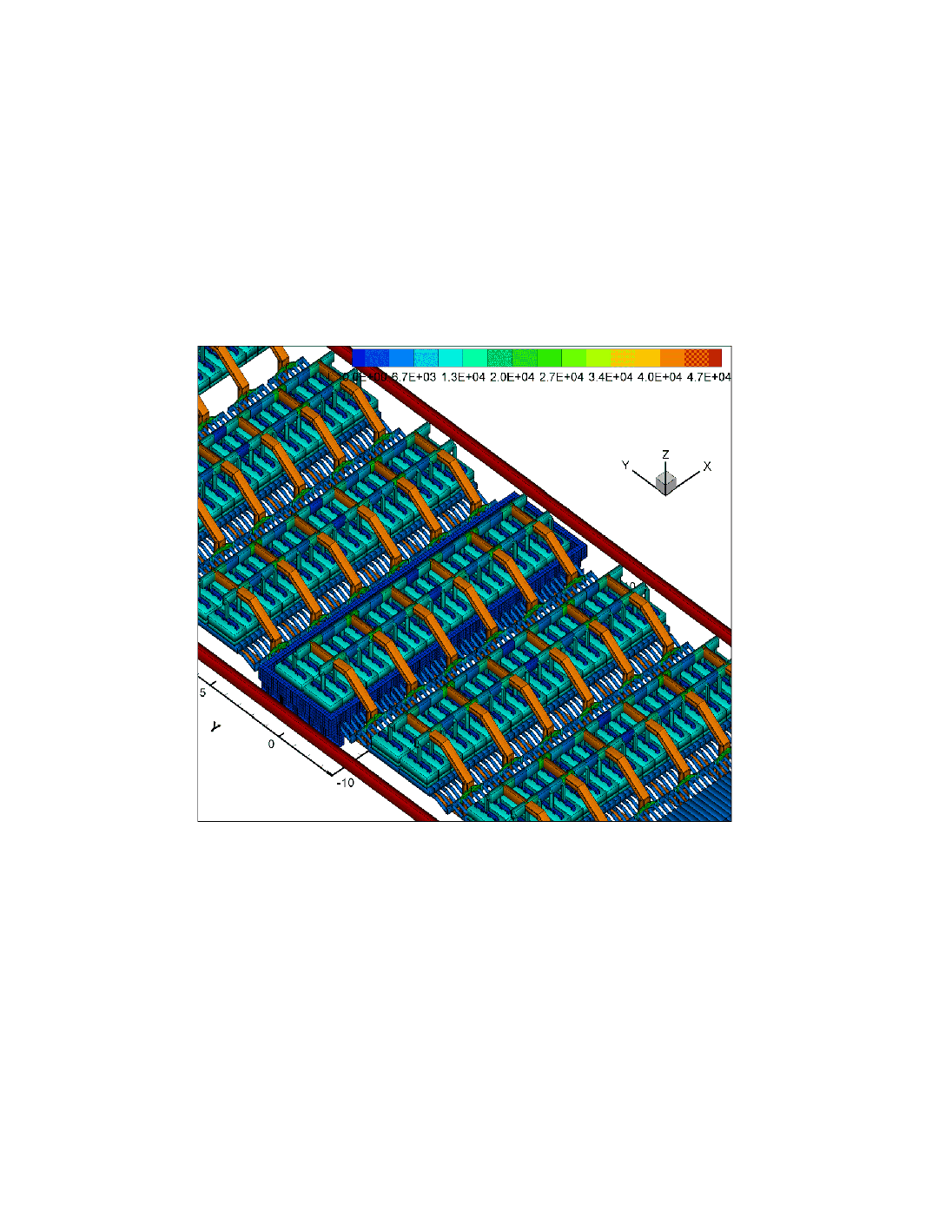
MHD-Valdis but this time using the busbar design inspired from the Pechiney 1987
patent [9] (see Figure 13). That busbar design is producing a more stable cell than the
one available in our 3D ANSYS® based 500 kA demonstration model, so it is better
suited for this comparative cell stability study.
A very similar stability analysis study of this 500 kA demonstration cell design
being that the metal level in the previous study was setup to 25 cm while it is set to 20
cm in the present case. The ledge toe thickness is set to 4 cm, very close to the anode
shadow, as it was in the previous study.
Figure 14 presents the obtained initial metal pad current density field. The
presented in Figure 6 because the busbar network is better balanced in the present case.