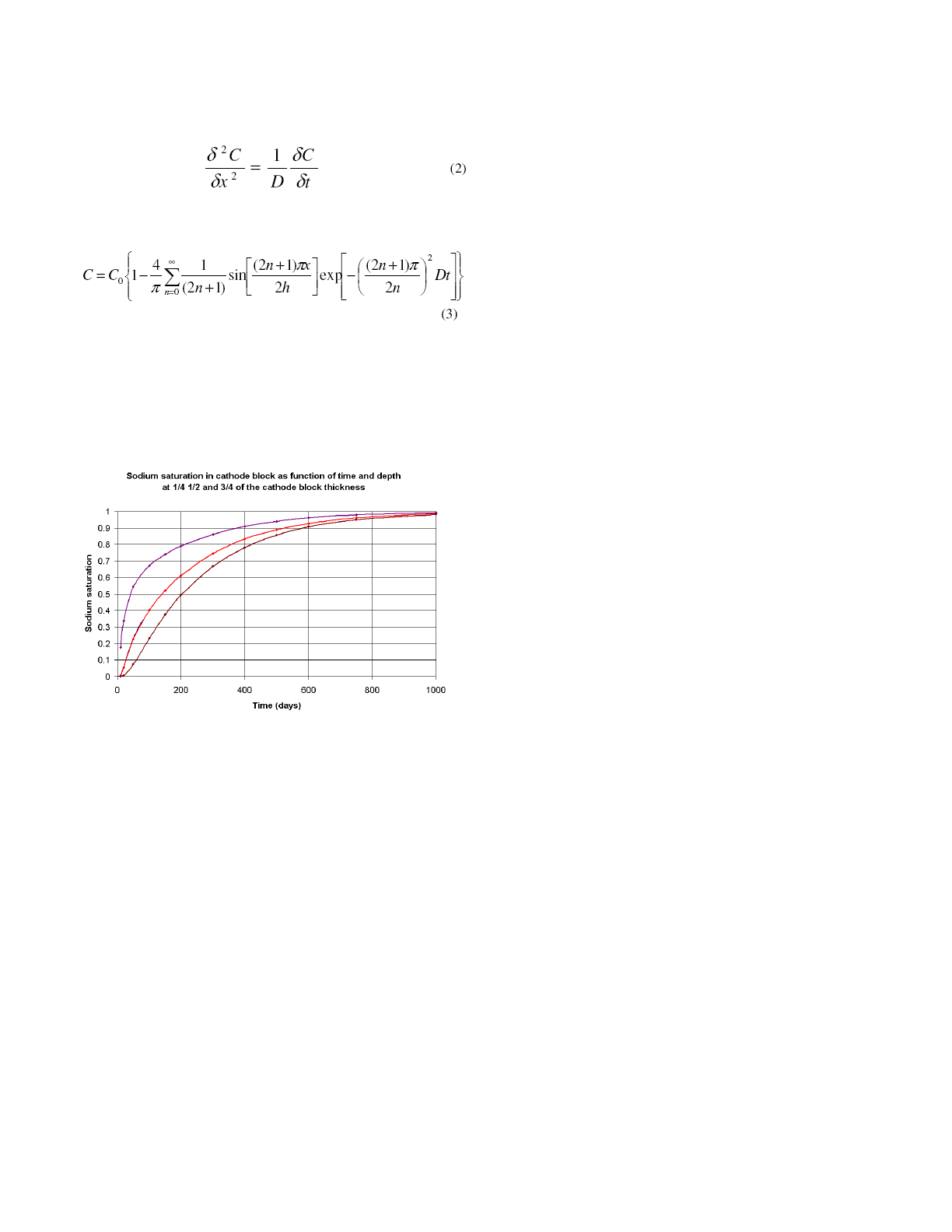
solving the diffusion partial differential equation:
diffusion equation also presented by Dewing [4]:
typical 45 cm thick cathode block, this time at x = ¼, ½ and ¾ of
the total block thickness as function of time as computed by
Equation 3. Figures 2 and 3 show that it takes about 80 days for
the sodium diffusion front to reach the bottom of the cathode block
and about 1000 days for the cathode block to be fully saturated in
sodium from top to bottom.
internal forces induced by the thermal changes and in addition,
gradually over a period of about 1000 days, the internal forces
induced by the chemical changes. To complicate further the matter,
the intensity of those internal chemical forces will depend on the
rigidity of the potshell structure itself.
have been developed in order to assist potshell design optimization
work. The ideal situation should allow to include all the physics
described above in a comprehensive model and to obtain fast and
accurate predictions from it. Speed, in addition to accuracy, is
required to be able to use any model to analyze various design
proposals relatively efficiently and hence converge on the optimum
potshell design in an acceptable time frame.
Alcan International by a group of experts under the leadership of
the author. Unfortunately, not much of that huge R&D effort was
published at that time. Yet, Read [5] presented that model at a
1990 supercomputer symposium in Montreal. Figure 1 of [5]
shows that the model includes the potshell and about half of the
lining material. Only the lining material directly under the cathode
become obvious, we shall name that type of model the "half empty
shell" type of model. The fact that that model was presented in a
supercomputing symposium and that we can read in [5] that "the
computational task, even in CRAY terms, is staggeringly large"
clearly indicates that the hope to be able to use that type of model
as an efficient design tool was not achieved at the time.
shell" type of model was successfully being used to improve
existing potshell design as reported in [6] or to quickly analyze
potshell design options like in [7] per example. As its name
indicates, that type of model only represents the geometry of the
potshell itself, which contribute to significantly reduce the
computational requirements. Yet, as it rely on an assumed internal
load, that type of model cannot take into account the relationship
that exist between the potshell rigidity and the intensity of the
internal forces.
90's [1,8]. In that type of model, the lining material between the
potshell and the cathode blocks is represented in addition to the
potshell itself hence the name "almost empty shell". In that third
type of model, instead of using an assumed internal load, an
iterative process ensures that the imposed internal load lies exactly
on the Dewing strain-stress relationship automatically ensuring that
a more rigid potshell is getting a larger internal load.
potshell mechanical models, hardware capabilities have increased
radically. A model that was way to big to be considered an efficient
design tool at the time might become practical. For that reason, it
is a good thing to revisit those three types of potshell mechanical
models and reassess their relative merits as efficient potshell design
tools.
other two types of models for that matter, is based on the usage of
the quadrilateral Finite Strain shell element (SHELL181) in the
commercial code ANSYS® [7]. The temperature distribution
applied as a body load to the entire potshell structure. Also for all
three types of model, it is possible to solve the mechanical problem
only by considering the elastic properties of the potshell steel
structure or to consider in addition the temperature dependent
isotropic hardening von Mises plasticity behavior of the potshell
steel structure using the MISO non-linear hardening option in
ANSYS® [7].
internal forces generated from the thermal and chemical lining
expansion to be specified as boundary conditions in the model.
Obviously, model boundary conditions are model inputs, while
those internal forces are a priori unknown and depend on the
potshell structural rigidity. The historical approach to this problem
is to rely on a database of past model validation exercises to define
an internal pressure (or forces) loading scheme based on the
cathode block size and position relative to the potshell. That
loading scheme is at best semi-empirical and is typically considered
as a trade secret, so it is never presented in publications.
forces) loading as boundary conditions, regardless of the quality
and quantity of previous field measurement campaigns and