the potshell design. The potshell must be designed in such a way
that it will not deform excessively in operation and will remain as
much as possible in elastic deformation mode. Yet, over-designed
potshell are very costly. So, it is important to achieve a design
where all sections are getting their fair share of the total load and
are being charged close to their elastic limit.
design without extensive use of mathematical modeling tools.
Three such tools are presented here in order of complexity namely
the "empty shell", the "almost empty shell" and the "half empty
shell" ANSYS® based thermo-mechanical models. Results are
as required CPU times.
internal forces induced by thermal and chemical changes in the
reduction cell. The thermal changes are quite straightforward to
assess if a complementary thermo-electric model is available [2].
The effect of those thermal changes of the cell can be separated into
two elements. First, the effect of the thermal changes that occurs in
the potshell itself is straightforward to assess. Second, the effect of
the thermal changes that occur in the lining: this one is much more
difficult to assess due to the complexity of the material properties
involved.
penetration into the carbon cathode blocks. This sodium
penetration makes the carbon swell and hence, the cathode blocks
expand chemically. Unfortunately, the physic of that chemical
expansion is not well understood. The key references on that
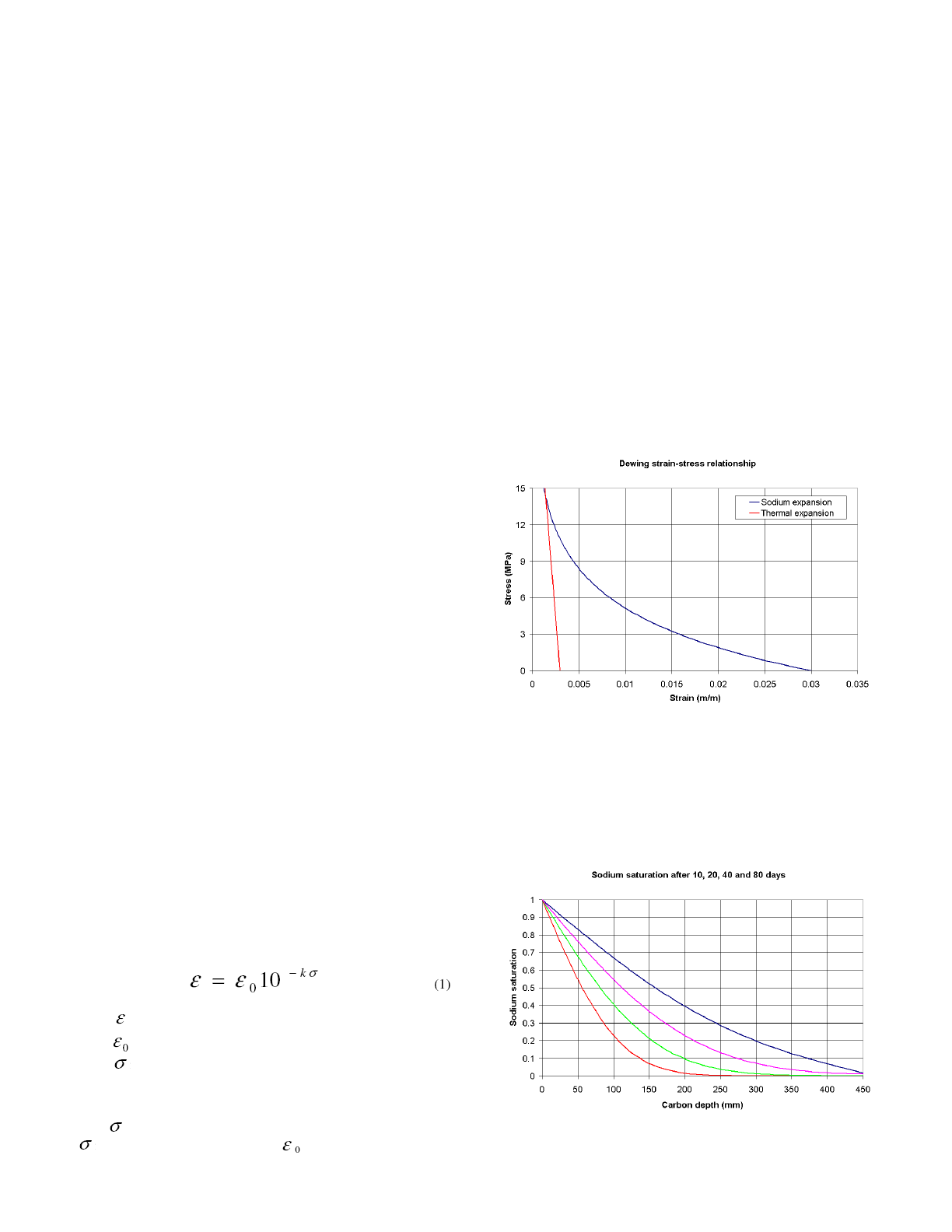
subjects are Rapoport [3] and Dewing [4]. According to Dewing,
the stress-strain relationship of the sodium swelling of the carbon
is:
when
quality. 3% is a typical value for 20% semi-graphitic cathode
grade, which is about ten times more that the thermal expansion.
cathode block having a 3% free expansion strain. For comparison,
a typical thermal expansion strain-stress relationship is also
presented.
be equal to 4E-5 cm2/s, which corresponds to 3.456E-4 m2/day.
45 cm thick cathode block for the full block thickness after 10, 20,
40 and 80 days.