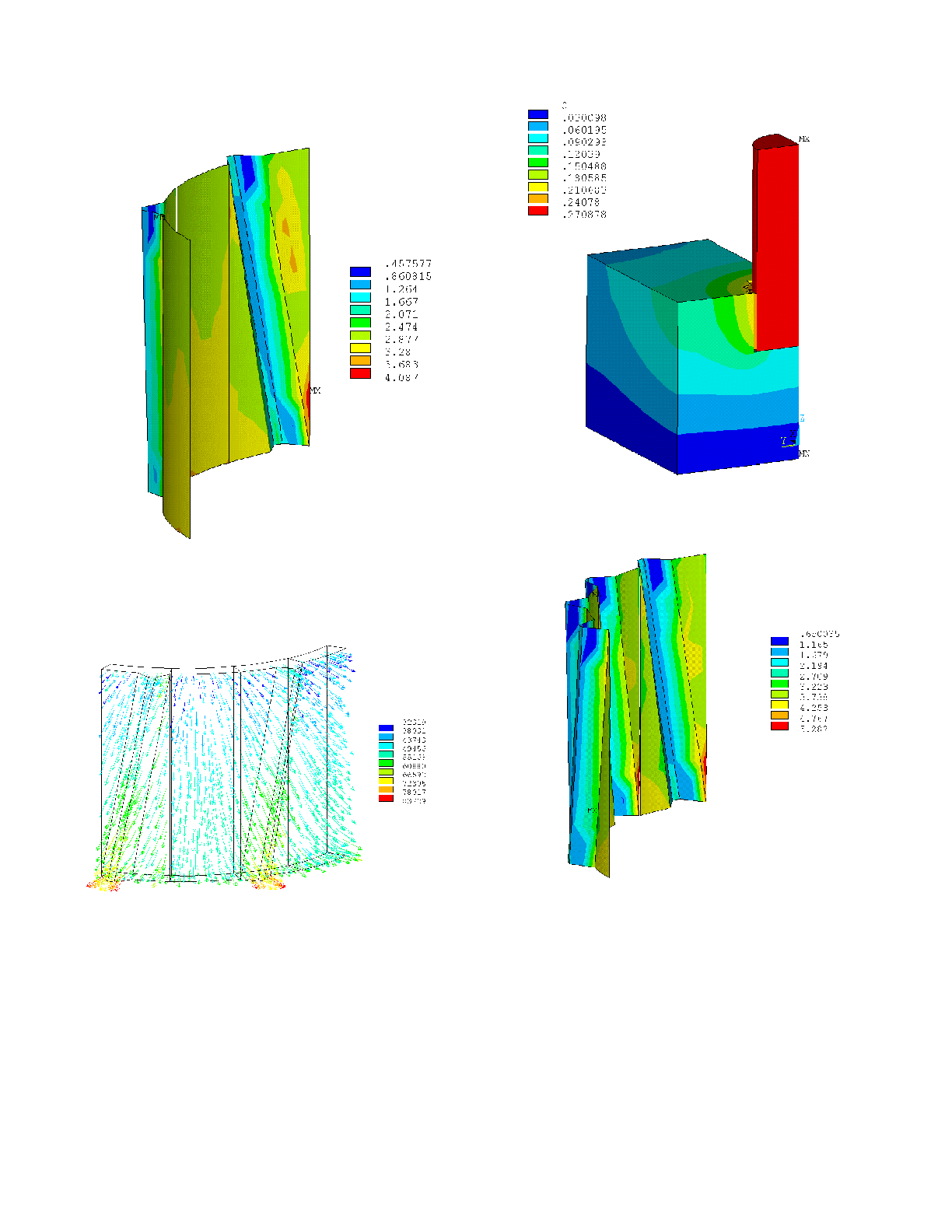
Figure 8
Cast iron/anode carbon interface contact pressure
(MPa)
Figure 9:
Current density distribution in the cast iron (A/m2)
Conclusions
An ANSYS® version 12.0 based fully coupled TEM anode stub
hole design tool have been successfully developed that is now
available to the whole aluminium industry through GeniSim Inc.
The ANSYS® based APDL model is parametric, which means that
for a given model topology, it is possible almost instantaneously to
edit the APDL model input file to change the model geometry and
submit another run.
Figure 10:
Model predicted voltage drop for the pressure and
temperature dependant contact resistance setup (V)
Figure 11
Cast iron/anode carbon interface contact pressure
(MPa)
The quarter stub hole model presented here solves in only around
4000 CPU seconds on a 64 bits dual core Intel Centrino T 9300
Cell Precision M6300 portable computer running ANSYS® 12.0
version. So this parametric ANSYS® based TEM anode stub hole
model is a very efficient tool to study alternative flutes design per
example.
A very quick flutes design optimization study revealed that a very
sight change in the flutes design aiming at increasing the contact
pressure of the flutes side faces should decrease the anode voltage
drop by 17 mV or 5.9% which represents a reduction of about 0.3