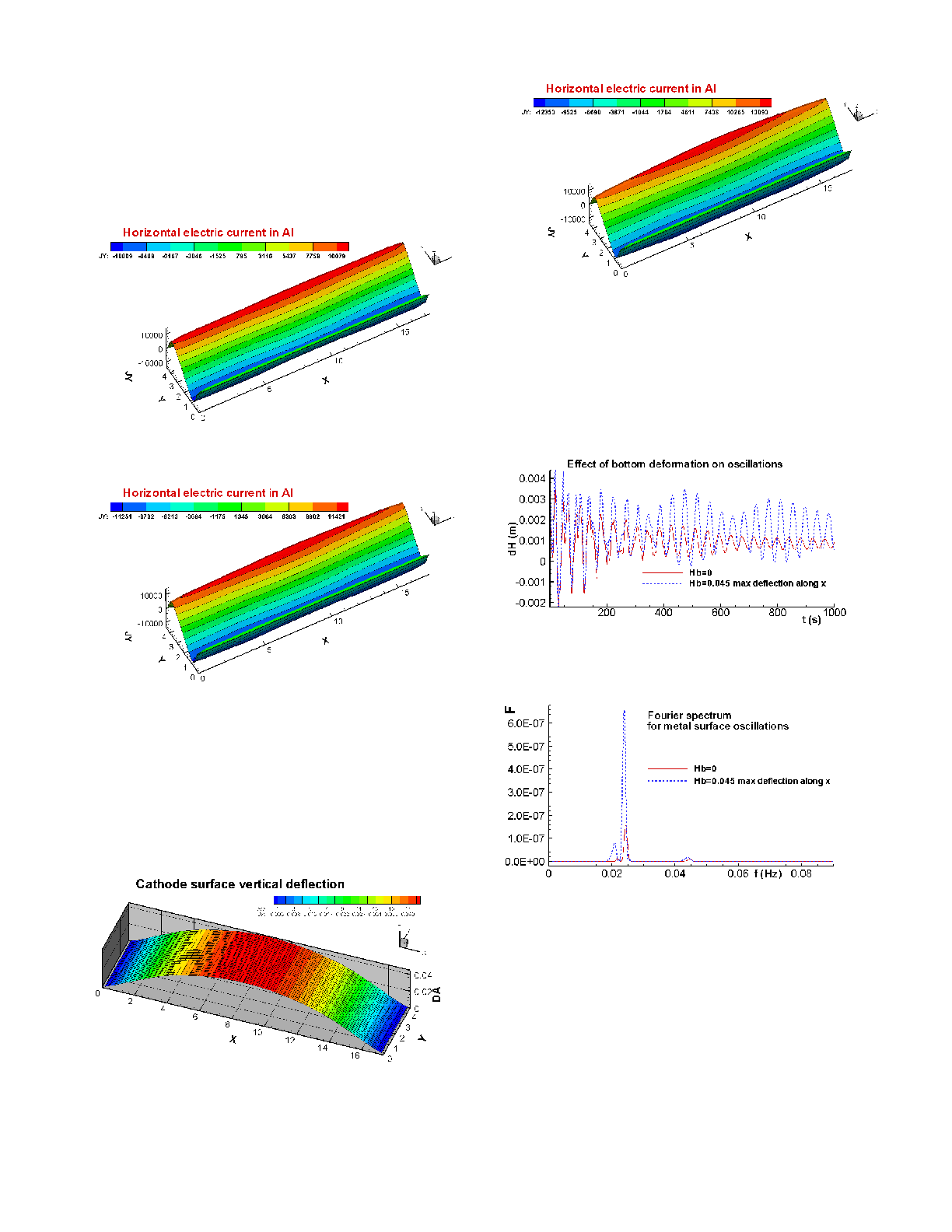
because a 2.25 cm middle cathode surface upward displacement is
not affecting too much the intensity of the horizontal current
density when the metal pad thickness in on average 20 cm deep as
we can see by comparing Figures 5 and 6 presenting the intensity
of the lateral (Y) horizontal metal pad current density initially
calculated using a flat bath/metal interface for both the flat bottom
profile and the deflected one.
calculated using a flat bath/metal interface and a flat bottom profile.
calculated using a flat bath/metal interface and a deflected (2.25 cm
max) bottom profile.
maximum relative vertical displacement will be more than 2.25 cm
for an AP potshell design as those potshells have stiffer upper side
wall than the potshell design modeled in [2]. For that reason, a
second metal pad bottom profile, this time with a 4.5 cm maximum
displacement (see figure 7) has also been modeled.
horizontal metal pad current density calculated using a flat
bath/metal interface.
calculated using a flat bath/metal interface and a deflected (4.5 cm
max) bottom profile.
the flat bottom base case with the one predicted when using the
bottom profile presented in Figure 7. Finally, Figure 10 compares
the Fourier power spectra of the two interface waves presented in
Figure 9.
without up to 4.5 cm of vertical displacement.
interface wave Fourier power spectra.
significantly decreased. It is quite obvious that with 4.5 cm
maximum bottom displacement and 20 cm average metal pad
thickness, we are getting very close to the cell instability threshold
clearly indicating that an excessive vertical potshell displacement
can render a cell with a good busbar design unstable.
measures like forced air cooling on the potshell walls in order to
prevent such an excessive vertical potshell displacement, for
example on the AP50 potshell.