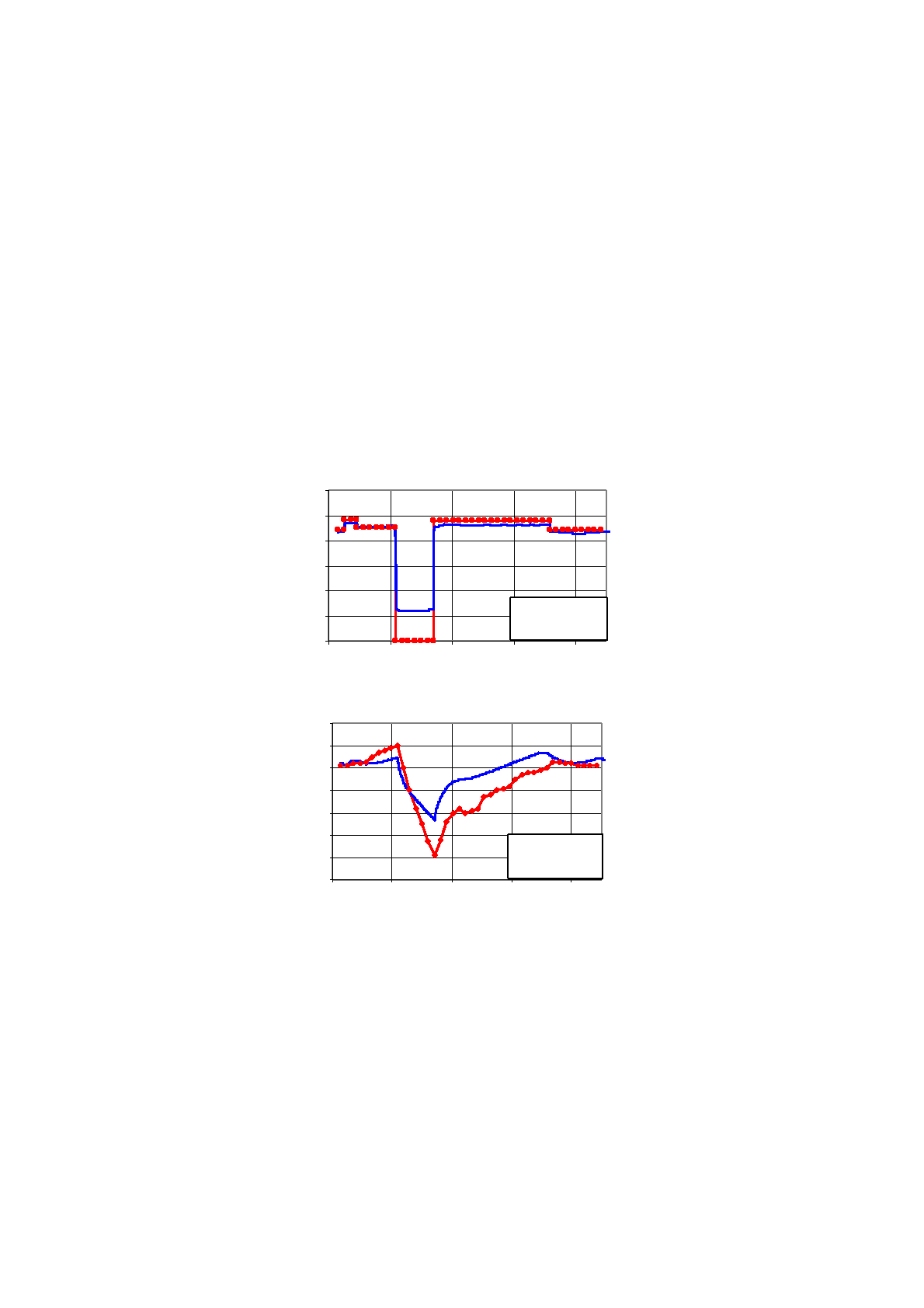
amplitude of both responses is significantly different.
all pot dimensions including shell, lining, anodes and busbar in conjunction with amperage
and voltage drop. In the exercise presented here, we assume that the single measured thermal
response is accurate (no measurement errors) and typical (the cell is in a stable and normal
state prior to the power modulation event). This may not be the case but only more
measurements can prove or disprove the assumption.
evaluated in addition to the pure dimensional figure. It is clearly shown in Figure 3 that the
invalidated model underestimates the amplitude of the real thermal response measured.
However, it is now impossible to get a clear comparison of the chemical response.
(last tapping, anode changing), demand feed (over- or underfeeding), chemical stability
(sludging, acidity) and thermal balance (over voltage, back-reaction or under cooling), which
is difficult to reproduce in a simulation. In the model, many parameters influence the
amplitude of the thermal response to a given perturbation, such as a 3-hour total power
shutdown, but two main effects are seen to determine pot behaviour. These are the heat
generation in the liquid bath and metal and the heat loss partition dissipating through the
ledge [9,10,11]. By reducing the mass of the liquid zone (i.e. less bath and less metal) and